Car Overheating in Fort Lauderdale: Radiator & Cooling System Repair Guide
- By John Xipolitidis
- Auto Repair Services, Heating & A/C
- May 15, 2026
An overheating engine needs attention quickly. The cause may be relatively straightforward, such as a coolant leak, or it may involve a thermostat, radiator, cooling fan, water pump, or another part of the cooling system. What matters first is avoiding additional heat while the engine is already outside its normal operating range.
Southport Auto Repair provides radiator and cooling-system repair in Fort Lauderdale for European, domestic, and Asian vehicles. This guide covers what to do if your car overheats, the common causes, and how proper diagnosis avoids guessing.
Quick answer: If the temperature warning comes on, the gauge moves into the hot range, or steam is coming from under the hood, move to a safe location and shut the engine off. Do not open a hot pressurized cooling-system cap. If the cause is unknown or the vehicle overheats again, arrange for diagnosis rather than continuing to drive.
What to Do If Your Car Is Overheating Right Now
Get out of active traffic when it is safe to do so and turn on your hazard lights if needed.
Once safely stopped, shut the engine down so it is no longer generating additional heat.
Do not rush to open the radiator, expansion tank, or another pressurized cooling-system cap.
If the cause is unknown, coolant is leaking, or the vehicle overheats again, towing may be safer than trying to drive it.
Never Open a Hot Cooling-System Cap
Cooling systems can remain hot and pressurized after the engine is shut down. Opening a pressurized cap while the system is hot can release steam and hot coolant and cause serious burns. AAA recommends safely pulling over and shutting the engine off when a vehicle is overheating rather than continuing to drive.
What the Cooling System Does
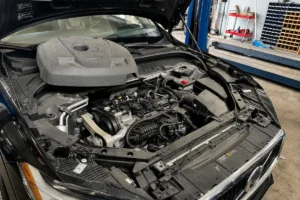
The engine creates heat whenever it runs. The cooling system manages that heat by circulating coolant through the engine and transferring heat to the radiator. Depending on the vehicle, the system can include the radiator, engine coolant, water pump, thermostat, cooling fans, hoses and pipes, expansion or overflow tank, temperature sensors and electronic controls, and the pressure cap or related pressure-control components. Some systems are mechanically simple; others are heavily integrated with electronic controls.
7 Common Reasons a Car Can Overheat
An overheating symptom does not identify the failed component by itself. Several very different cooling-system faults can cause the temperature to rise.
Coolant loss reduces the system's ability to control temperature. Leak sources include hoses, the radiator, water pump, thermostat housing, expansion tank, and other cooling-system components.
The thermostat regulates coolant flow based on temperature. A thermostat that does not operate correctly can interfere with normal cooling-system circulation.
The water pump circulates coolant. Leakage, bearing problems, drive issues, or an internal pump failure can affect circulation depending on the vehicle's design.
A radiator can leak, become damaged, or lose cooling efficiency because of internal or external problems. But replacing the radiator simply because the gauge went up would be guessing.
Electric fans and their controls move air through the radiator when vehicle speed alone does not provide enough airflow.
After repairs, coolant loss, or other system problems, trapped air or poor circulation may interfere with normal cooling.
Some overheating complaints involve more than the radiator. Internal engine problems, combustion-gas leakage, or lubrication problems may also contribute depending on the vehicle and symptoms.
Why Does My Car Overheat Only in Traffic?
This symptom is useful because airflow changes dramatically between sitting at a red light and driving at road speed. At speed, air naturally moves through the radiator and condenser. At low speed or while stopped, electric cooling fans or a mechanically driven fan system play a larger role in airflow. A cooling-fan problem is therefore one possibility when a vehicle becomes hot in traffic but cools down while moving.
But it is not automatically the fan. Low coolant, a weak water pump, thermostat problems, radiator restrictions, and other cooling-system conditions can also behave differently at idle and at road speed. The pattern helps diagnosis, but it does not confirm the part. Heavy air-conditioning use adds heat load to the system as well; if your AC is also struggling, see our car AC repair guide. BMW owners can find model-specific cooling guidance in our BMW maintenance schedule.
What Does a Coolant Leak Look Like?
Coolant color is not universal. Depending on the manufacturer and coolant specification, it can appear green, orange, yellow, pink, blue, violet, or another color. Possible signs of coolant loss include a puddle or wet area beneath the vehicle, residue around hoses or connections, a low-coolant warning, repeatedly needing to add coolant, a sweet-smelling odor, steam from the engine compartment, or temperature climbing above its normal range. If the level keeps dropping, find out where it is going rather than treating repeated top-offs as normal maintenance. And never top off a hot pressurized system: if the vehicle is actively overheating, the priority is getting safely stopped and letting the engine cool. Correct coolant must meet the vehicle manufacturer's specification; NHTSA specifically recommends checking the owner's manual. Plain water does not provide the same corrosion, boiling-point, and freeze-protection characteristics as the proper coolant mixture.
How Often Should Engine Coolant Be Changed?
There is no responsible universal Fort Lauderdale interval for every vehicle. Coolant chemistry, cooling-system design, and manufacturer recommendations vary substantially. Some vehicles use time-based intervals, some use mileage and time, and others have vehicle-specific maintenance requirements. Follow the maintenance schedule and coolant specification for the actual vehicle.
Hot weather is a good reason to pay attention to cooling-system condition. It is not a reason to replace every manufacturer's coolant interval with a blanket mileage or time rule. Our Fort Lauderdale maintenance guide explains why manufacturer-specific intervals should remain the starting point.
Diagnosis Before Parts
An overheating symptom does not automatically mean you need a radiator, and a coolant leak does not automatically identify where the system is leaking. When an overheating vehicle reaches the shop, the process is: understand the symptom, inspect the cooling system, test the suspected cause, and explain the repair and the cost before any authorized work moves forward. Cooling-system repair should never be guessing.
Cooling System FAQ
What should I do if my car starts overheating?
Move to a safe location and shut the engine off. Do not open a hot pressurized cooling-system cap. Allow the vehicle to cool fully. If the cause is unknown, coolant is leaking, or the vehicle overheats again, arrange for diagnosis rather than continuing to drive.
Why does my car overheat only in traffic?
Cooling-fan operation is one possible cause because fans become more important when there is little natural airflow through the radiator. Low coolant, thermostat problems, radiator restrictions, circulation issues, and other faults can create similar symptoms, so testing is needed.
How often should coolant be changed?
Follow the vehicle manufacturer's maintenance schedule and coolant specification. There is no single mileage or time interval that applies to every vehicle in Fort Lauderdale.
Can I use plain water instead of coolant?
Plain water should not be treated as the normal replacement for the manufacturer's specified coolant mixture. Correct coolant provides boiling-point, freezing, and corrosion protection. Never open a hot pressurized cooling system simply to add fluid.
Does white exhaust mean I have a blown head gasket?
Not automatically. Condensation can produce visible vapor, especially after a cold start. Persistent abnormal exhaust combined with coolant loss, overheating, or other engine symptoms may justify further testing for an internal engine problem.
Temperature Rising or Coolant Leaking?
Call Southport Auto Repair and tell us exactly what the vehicle is doing. Overheating, coolant loss, and temperature warnings can have different causes, and the right repair starts with identifying the actual problem.
101 SW 17th St, Fort Lauderdale, FL 33315
Monday-Friday: 8:00 AM-6:00 PM
Overheating safety guidance reflects AAA recommendations to pull over and shut the engine off rather than continue driving. Coolant specification guidance reflects NHTSA's recommendation to follow the owner's manual. Service intervals and coolant specifications vary by vehicle; follow the manufacturer's maintenance schedule for the actual vehicle.
Your BMW’s Maintenance Schedule: What It Actually Needs in Fort Lauderdale (and When)
CV Axle Replacement in Fort Lauderdale: Clicking, Vibration & Torn Boot Signs
Wheel Bearing Replacement Fort Lauderdale: 7 Warning Signs and 2026 Cost Guide
8 Best Options for Reliable Engine Tune Up Fort Lauderdale Drivers Trust
Catalytic Converter Repair in Fort Lauderdale: P0420, Warning Signs & Diagnosis