Catalytic Converter Repair in Fort Lauderdale: P0420, Warning Signs & Diagnosis
Catalytic converters can be expensive, which makes accurate diagnosis especially important. A check engine light, reduced power, exhaust noise or catalyst-efficiency code can point the diagnostic process toward the exhaust and emissions system, but those symptoms do not automatically identify one failed part.
Southport Auto Repair works on engine, exhaust and diagnostic problems in Fort Lauderdale for European, domestic and Asian vehicles. The goal is to determine what the vehicle actually needs before recommending an expensive replacement.
Quick answer: P0420 and P0430 are catalyst-efficiency trouble codes. They can be important clues, but a trouble code by itself is not a complete diagnosis. Converter condition, exhaust leaks, oxygen-sensor operation, engine performance and other relevant information may need to be checked before replacement is recommended.
What Does a Catalytic Converter Actually Do?
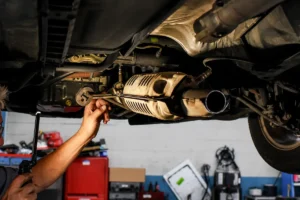
The catalytic converter is part of the vehicle's exhaust and emissions-control system.
EPA explains that catalytic converters have been installed on most passenger cars and light-duty trucks since the 1970s to reduce harmful exhaust emissions.
Modern three-way catalytic converters help reduce three major categories of pollutants:
- Hydrocarbons
- Carbon monoxide
- Oxides of nitrogen
The catalyst uses precious metals and a high-surface-area internal structure to help convert those pollutants into less harmful exhaust gases.
Because the converter is part of the emissions-control system, federal rules also govern how replacement converters are selected and installed.
What Do P0420 and P0430 Mean?
P0420 generally refers to catalyst-system efficiency being below the expected threshold on Bank 1. P0430 is the corresponding catalyst-efficiency code for Bank 2 on vehicles that have a second engine bank.
The important word is efficiency.
The vehicle's onboard diagnostic system monitors catalyst performance using information from the emissions-control system, including oxygen-sensor data. When the computer determines catalyst performance is outside the expected range, it can store a catalyst-efficiency code.
P0420 Does Not Tell You Which Part to Buy
A scan code tells you what condition the vehicle's computer detected. Diagnosis still has to determine why that condition exists. Clearing the code without addressing the cause may simply result in the warning returning once the monitor runs again.
Our Fort Lauderdale engine diagnostics guide explains why a trouble code should be treated as the start of diagnosis rather than a parts list.

Catalyst-efficiency codes provide useful diagnostic information, but additional testing may be needed before an expensive exhaust component is replaced.
6 Signs That Can Point Toward a Catalytic Converter or Exhaust Problem
These symptoms can occur with catalyst problems, but several can also be produced by other engine or exhaust faults.
Check Engine Light
A catalyst-efficiency code such as P0420 or P0430 can point diagnosis toward catalyst performance, but the stored code should be evaluated with the rest of the vehicle's data and symptoms.
Loss of Power
A physically restricted exhaust can reduce engine performance. Because many other engine problems can also cause poor acceleration, the symptom alone does not prove the converter is restricted.
Rattling from the Exhaust
Damaged internal catalyst material can sometimes create a rattle inside the converter housing. Exhaust shields, brackets and other components can also create underbody rattles.
Unusual Exhaust Odor
Abnormal exhaust odor can accompany fuel-mixture, catalyst or engine problems. Smell is useful diagnostic information, but it is not enough to identify a failed converter on its own.
Reduced Fuel Economy
Changes in fuel economy can accompany engine-management or exhaust problems, but there are many possible causes. Avoid diagnosing a converter based on a mileage change alone.
Suddenly Very Loud Exhaust
If the vehicle suddenly becomes dramatically louder, the exhaust system may be damaged, disconnected or missing a component. Have the system inspected before assuming exactly what was lost or broken.
Can an Engine Problem Damage a Catalytic Converter?
Yes. EPA guidance notes that original catalytic converters are designed to provide long service when a vehicle is properly maintained, while poorly maintained or malfunctioning vehicles can damage converters.
That is one reason the engine should not be ignored when diagnosing catalyst problems.
Conditions that may contribute to catalyst damage include:
- Severe or prolonged engine misfires
- Incorrect air-fuel mixture
- Engine oil entering the combustion process
- Coolant entering the combustion process
- Physical impact or exhaust-system damage
- Other engine-management problems that affect exhaust composition
A Flashing Check Engine Light Deserves Prompt Attention
A flashing malfunction-indicator light can indicate a severe misfire. Severe misfire conditions can expose the catalytic converter to damaging temperatures, so reduce driving and have the vehicle evaluated promptly.
Does a Bad Oxygen Sensor Always Cause a P0420 Code?
No. And a P0420 code does not automatically prove an oxygen sensor is bad either.
Oxygen sensors are part of the information the engine computer uses for emissions monitoring and fuel control. Sensor performance, wiring, exhaust leaks, engine operation and catalyst condition can all matter during diagnosis.
Replacing an oxygen sensor simply because the word “catalyst” appears in a trouble code is still parts swapping.
The same principle works in the other direction: replacing a converter before confirming the underlying condition can also be unnecessarily expensive.
How Is a Catalytic Converter Problem Diagnosed?
The exact process depends on the vehicle and symptoms. There is no single universal test that should be advertised as the procedure for every car.
Warning lights, stored codes, noises, loss of power and recent repair history help establish where testing should begin.
Misfires and other engine faults can be relevant because catalyst performance depends on the exhaust entering the converter.
Exhaust leaks, physical damage and other system conditions may need to be ruled out depending on the code and symptoms.
If replacement is appropriate, the correct converter and installation requirements depend on the particular vehicle.
Why the Correct Replacement Converter Matters
A catalytic converter is not simply a universal muffler-style part that can be installed on any vehicle.
EPA guidance requires installers using aftermarket catalytic converters to select the proper converter for the vehicle and install the appropriate type in the correct location.
Vehicle application, engine configuration and emissions requirements can all affect which converter is appropriate.
Federal Rules Apply Even If Florida Does Not Require a Routine Local Emissions Test
A vehicle's emissions equipment still has to comply with applicable federal requirements. The absence of a routine local inspection does not make it acceptable to remove, bypass or install an inappropriate emissions-control component.
EPA's consumer and installer guidance is available here: Aftermarket Catalytic Converter Guidance .
How Much Does Catalytic Converter Repair Cost in Fort Lauderdale?
There is no useful one-price answer.
Converter cost can vary dramatically between vehicles because the part itself, exhaust layout and labor required are different.
Factors that can affect the repair include:
- Vehicle year, make and model
- Engine configuration
- Number and location of catalytic converters
- Whether the converter is integrated into another exhaust component
- Availability of an appropriate compliant replacement
- Condition of exhaust hardware and surrounding components
- Whether another engine or emissions fault also needs repair
- Labor required to access and replace the failed component
This is why the previous blanket price chart has been removed. A converter on one vehicle can be a very different job from a converter on another.
The useful number is the estimate for your vehicle after the fault and required repair have been identified.
Can You Keep Driving With a Catalytic Converter Problem?
It depends on what the vehicle is doing.
A stored catalyst-efficiency code on an otherwise normally running vehicle is different from a vehicle that has a severe misfire, significant loss of power, overheating exhaust components or another serious drivability problem.
Do Not Use “It Still Moves” as the Safety Test
If the engine is shaking badly, the check engine light is flashing, power drops substantially, the exhaust becomes extremely hot, the vehicle stalls or another serious symptom develops, stop and get advice rather than assuming a short drive is automatically safe.
If you are unsure, call the shop and describe the exact symptoms before deciding whether to drive or tow the vehicle.
What If the Catalytic Converter Was Stolen?
A missing converter creates a very different problem from a catalyst-efficiency code.
Depending on where the component was removed, you may notice:
- A sudden and extremely loud exhaust
- Exhaust noise coming from beneath the vehicle
- A check engine light
- Visible cut or missing exhaust components
- Exhaust fumes in an unusual location
Do not crawl underneath a vehicle parked in an unsafe location to investigate it. If you suspect theft, have the exhaust inspected and contact your insurer or law enforcement as appropriate.
We are intentionally not claiming that Southport provides custom anti-theft fabrication or VIN etching unless that service is specifically confirmed by the shop.
European Catalytic Converter and Emissions Problems
European vehicles can use complex exhaust layouts, multiple oxygen sensors, multiple catalyst assemblies and manufacturer-specific diagnostic information.
The same principle still applies: a fault code should be diagnosed on the actual vehicle rather than treated as an automatic authorization to replace the most expensive component in the system.
Southport works on European vehicles including BMW, Mercedes-Benz, Audi, Porsche, Land Rover, MINI, Volkswagen, Jaguar, Volvo and Bentley.
Diagnose the Problem Before Replacing the Expensive Part
Southport Auto Repair is a family-owned Fort Lauderdale repair shop serving the area since 2009.
When an emissions or exhaust problem points toward an expensive component, the sensible approach is to understand why the warning is present before deciding what the vehicle needs.
That is especially important when a customer arrives with a trouble code from a parts-store scan or another shop's estimate.
Southport works on European, domestic and Asian vehicles and communicates the repair and cost before authorized work moves forward.
- Family-owned Fort Lauderdale repair shop
- Serving the area since 2009
- Check engine light and engine diagnostics
- Exhaust and emissions-related troubleshooting
- European vehicle experience
- Domestic and Asian vehicles also serviced
- Repair cost communicated before authorized work proceeds
Catalytic Converter Repair FAQ
Does P0420 automatically mean I need a catalytic converter?
No. P0420 indicates that the vehicle's onboard diagnostic system has detected catalyst efficiency below the expected threshold on Bank 1. Diagnosis may still need to consider converter condition, oxygen-sensor operation, exhaust leaks, engine performance and other relevant factors before replacement is recommended.
What is the difference between P0420 and P0430?
Both are catalyst-efficiency codes. P0420 applies to Bank 1. P0430 applies to Bank 2 on vehicles equipped with a second engine bank.
Can an engine misfire damage a catalytic converter?
Yes. A severe or prolonged misfire can send unburned fuel into the exhaust and expose the converter to damaging temperatures. A flashing check engine light can indicate a severe misfire and deserves prompt attention.
Can I drive with a catalytic converter problem?
It depends on the symptoms. A catalyst-efficiency code on a normally running vehicle is different from severe loss of power, a flashing check engine light, stalling or other serious drivability problems. If the vehicle is running badly, call for advice before continuing to drive.
How much does catalytic converter replacement cost?
Cost varies significantly by vehicle, engine configuration, converter location, number of converters, parts availability, emissions requirements and labor. The useful estimate is the one for your particular vehicle after the required repair has been confirmed.
P0420, P0430 or an Exhaust Problem in Fort Lauderdale?
Call Southport Auto Repair and tell us what the vehicle is doing. A catalyst-efficiency code, warning light, rattling exhaust or loss of power can have different causes, and the right repair starts with figuring out what is actually wrong.
101 SW 17th St, Fort Lauderdale, FL 33315
Monday-Friday: 8:00 AM-6:00 PM
Catalytic converter and replacement guidance: U.S. Environmental Protection Agency
On-board diagnostics information: U.S. Environmental Protection Agency OBD Guidance