CV Axle Replacement in Fort Lauderdale: Clicking, Vibration & Torn Boot Signs
- By John Xipolitidis
- Automobile
- Jul 6, 2026
A repeated clicking sound during a tight turn is one of the symptoms commonly associated with a worn CV joint. But clicking, clunking and vibration can also come from other steering, suspension, wheel or drivetrain components.
That is why the right first step is an inspection rather than assuming a sound automatically means you need an axle.
Quick answer: A CV axle transfers power to a driven wheel while its joints allow movement as the suspension travels and, on steering wheels, as the wheel turns. A torn protective boot can allow grease to escape and contamination to enter. Clicking on turns, grease around the inside of a wheel or a damaged boot are good reasons to have the axle inspected.
What Is a CV Axle?
CV stands for constant velocity.
On many front-wheel-drive and all-wheel-drive vehicles, CV axles transfer torque from the transmission, transaxle or differential to the driven wheels.
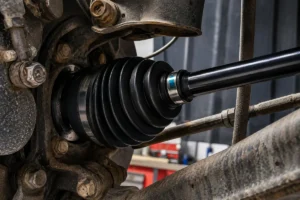
A typical axle assembly includes:
- An axle shaft
- An inner CV joint
- An outer CV joint
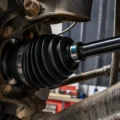
- Protective CV boots
- Grease inside the joints
- Hardware and splined connections at the drivetrain and wheel hub
The joints allow the axle to transmit power while operating at changing angles as the suspension moves. On a driven steering axle, the outer joint also has to accommodate steering movement.
Kelley Blue Book describes the protective boots as helping keep axle grease inside while keeping water and dirt away from the joint.
6 Signs a CV Axle or CV Joint Should Be Inspected
Clicking While Turning
Repeated clicking during a tight turn while the vehicle is moving under power is commonly associated with wear in an outer CV joint. Other components can make similar noises, so the source should still be confirmed.
Clunking During Acceleration or Deceleration
Excess movement in a drivetrain component can sometimes create a clunk when load changes. CV joints are one possibility, but mounts, suspension parts and other drivetrain components can also produce clunks.
Grease Around the Wheel or Suspension
A damaged CV boot can allow joint grease to escape. Because the axle rotates, grease may be thrown onto nearby suspension components or the inside of the wheel.
Visible Torn CV Boot
A split or damaged boot deserves attention even before the joint becomes noisy. Once the boot can no longer contain grease and keep contaminants out, joint condition can deteriorate.
Vibration Under Acceleration
Some worn axle or inner-joint problems can contribute to vibration under load. Tires, wheels, suspension, mounts and other drivetrain components can create similar symptoms, so vibration needs diagnosis.
Sudden Change in Drivetrain Operation
A severely damaged axle or joint can eventually interfere with power transfer. If the vehicle suddenly loses the ability to move normally, develops severe vibration or makes major mechanical noises, stop and have it evaluated.
Why Does a Worn CV Joint Click During a Turn?
The outer CV joint has to operate through a larger angle when the steering is turned.
When internal joint surfaces are worn or damaged, that increased operating angle can make looseness or irregular movement more noticeable. The result may be a repeating clicking or popping noise during a tight turn.
Clicking Is a Symptom, Not a Countdown
There is no responsible rule saying a clicking joint has exactly a few hundred or a few thousand miles remaining. How quickly a condition progresses depends on the specific joint, the amount of wear, driving, contamination and other factors.
If the clicking is new, get the source identified instead of trying to predict a failure date from mileage alone.
What Happens When a CV Boot Tears?
The boot protects the joint and its lubricant.
Once a boot is torn or split, grease can escape and water, dirt or other contaminants may reach the joint.
That does not mean every torn boot automatically requires an entire new axle at that exact moment.
The repair decision depends on factors such as:
- Whether the joint is already making noise
- Whether contamination has entered the joint
- How much grease has been lost
- The condition of the joint itself
- The vehicle and axle design
- Parts availability
- The labor involved in boot-only repair versus axle replacement
Finding a Torn Boot Early Can Matter
A boot problem discovered before substantial joint damage gives the shop more information and potentially more repair options. Once the joint itself is worn or contaminated, replacing the complete axle assembly is often the more practical repair.
CV Boot Replacement vs. Complete CV Axle Replacement
There is no universal rule that boot replacement is always cheaper, always better or only possible within a specific number of miles.
| Condition | What May Be Considered | Why Inspection Matters |
|---|---|---|
| Boot damaged but joint appears healthy | Boot service may be an option on some vehicles. | The joint condition and economics of the repair need to be evaluated. |
| Joint already clicking or worn | Complete axle replacement is commonly considered. | A new boot does not repair internal joint wear. |
| Significant grease loss or contamination | Joint condition needs closer evaluation. | Dirt and inadequate lubrication can damage internal surfaces. |
| Axle physically damaged | Complete axle replacement may be required. | A boot repair cannot correct a damaged shaft or failed joint. |
Kelley Blue Book notes that replacing the complete axle with a new or remanufactured assembly has become a common approach because rebuilding an individual worn CV joint can involve substantial labor.
Should Both CV Axles Be Replaced at the Same Time?
Not automatically.
CV axles do not work like brake pads, where friction components on the same axle are generally serviced as a pair.
If one CV axle has a failed joint and the other axle is operating normally, the condition of the other side should be evaluated rather than replacing it solely because both axles have the same mileage.
Replacement of both sides may make sense when both sides have confirmed problems, but there is no universal mileage such as 100,000 or 150,000 miles that automatically requires replacing both.
Age Alone Is Not the Diagnosis
An older axle can still have intact boots and normal joints. A lower-mileage axle can develop damage after a boot failure or physical impact. Condition matters more than choosing one mileage number for every vehicle.
Can a Bad CV Axle Cause Vibration?
It can, particularly when an inner joint or axle has developed wear or another mechanical problem.
But vibration is one of the easiest symptoms to misdiagnose because many other conditions can feel similar.
Other possible sources include:
- Tire imbalance or tire damage
- Bent wheels
- Wheel-bearing problems
- Engine or transmission mounts
- Suspension wear
- Other drivetrain components
The old article claimed CV-related vibration normally appears between a specific pair of highway speeds. I would not use a fixed speed range as a diagnosis.
Can a CV Axle Make the Car Pull?
A driveline problem can sometimes affect how the vehicle feels under acceleration, but pulling or wandering has many possible causes.
Tire pressure, tire condition, wheel alignment, suspension problems, brake drag and other issues can all contribute to a vehicle pulling.
A pull should therefore be diagnosed based on the complete symptom rather than automatically blamed on a CV axle.
Can You Drive With a Bad CV Axle?
There is no responsible answer of “yes for a few weeks” or “yes for a few thousand miles.”
How serious the condition is depends on what has actually failed.
A torn boot discovered during routine service is different from a heavily worn joint that is clicking loudly, vibrating or interfering with normal drivetrain operation.
Stop Driving if the Vehicle Is No Longer Operating Normally
If you develop severe vibration, major clunking, sudden drivetrain noise, loss of normal power transfer or another symptom that makes the vehicle difficult to control, stop in a safe location and arrange for it to be evaluated.
If you only recently noticed clicking or found grease around a wheel, call the shop and describe the symptoms. We can help determine the appropriate next step.
Does CV Axle Replacement Require a Wheel Alignment?
Not every CV axle replacement automatically requires an alignment.
Whether alignment is appropriate depends on the vehicle, how the axle is accessed, whether suspension or steering components are disturbed, existing tire wear and whether the vehicle already has alignment symptoms.
The old article advertised an alignment check as included with every axle replacement. Unless that is a confirmed Southport policy for every repair, it should not be presented as a blanket promise.
How Much Does CV Axle Replacement Cost in Fort Lauderdale?
There is no useful single price for every axle replacement.
Cost can vary based on:
- Vehicle year, make and model
- Front-wheel drive, rear-wheel drive or all-wheel drive configuration
- Front or rear axle location
- Axle design and accessibility
- New, remanufactured or other appropriate replacement options
- Associated seals or hardware required for the repair
- Additional damaged components
- Labor required for the specific vehicle
That is why the old fixed $380-to-$1,100 pricing chart has been removed. A straightforward axle on one car can be substantially different from the repair on an AWD European vehicle.
The useful price is the estimate for the actual vehicle after the failed component has been identified.
European CV Axle and Drivetrain Repair
European vehicles can use different axle designs depending on drivetrain, suspension layout, engine output and all-wheel-drive configuration.
A BMW xDrive vehicle, Audi quattro model, Mercedes-Benz 4MATIC vehicle or Porsche AWD system should not be treated as though its axle layout is identical to a basic front-wheel-drive commuter car.
Southport works on European vehicles along with domestic and Asian makes.
What Happens When Southport Checks a CV Axle Complaint?
The inspection should be driven by the symptom rather than one rigid checklist.
Tell us whether it happens while turning, accelerating, decelerating or at a particular driving condition.
Boots, axle condition and related wheel, suspension or drivetrain components can be evaluated based on the complaint.
Clicking and vibration should be traced to the component actually causing the symptom rather than automatically blamed on the axle.
Southport communicates what was found and the repair cost before authorized work moves forward.
Fix the Component That Is Actually Causing the Problem
Southport Auto Repair is a family-owned Fort Lauderdale repair shop serving the area since 2009.
Clicking, clunking and vibration can come from several parts of the vehicle, which is why we do not want to sell an axle simply because a symptom sounds familiar.
The goal is to identify the problem, explain what the vehicle needs and communicate the cost before authorized repair work moves forward.
- Family-owned Fort Lauderdale repair shop
- Serving the area since 2009
- Drivetrain and suspension repair
- European vehicle experience
- Domestic and Asian vehicles also serviced
- Direct communication about recommended work
Learn more about the shop on our About Southport Auto Repair page.
CV Axle Replacement FAQ
What does a bad CV joint sound like?
A worn outer CV joint is commonly associated with repeated clicking or popping during tight turns under power. Inner-joint or other drivetrain problems may create clunking or vibration. Because several components can make similar noises, the source should be inspected before replacement.
How long can I drive with a clicking CV joint?
There is no dependable mileage countdown. The amount of wear, joint condition, contamination and driving conditions all affect how a problem progresses. Have a newly developed clicking sound diagnosed rather than trying to predict how many miles remain.
Can a torn CV boot be repaired without replacing the axle?
Sometimes. If the boot is damaged but the joint remains in good condition, boot service may be an option on some vehicles. If the joint is already worn, noisy or significantly contaminated, complete axle replacement may be more appropriate.
Should I replace both CV axles together?
Not automatically. Each side should be evaluated based on its own condition. Replacing both can make sense when both have confirmed problems, but mileage alone does not automatically require replacing the opposite side.
Can a bad CV axle cause vibration?
Yes, a worn or damaged axle or inner CV joint can contribute to vibration. Tires, wheels, wheel bearings, mounts, suspension parts and other drivetrain components can create similar symptoms, so vibration should be diagnosed before an axle is replaced.
Hearing Clicking, Clunking or Drivetrain Vibration?
Call Southport Auto Repair and tell us when the symptom happens. A torn boot, worn CV joint, wheel problem or another drivetrain issue can create similar symptoms, and the right repair starts with identifying the actual cause.
101 SW 17th St, Fort Lauderdale, FL 33315
Monday-Friday: 8:00 AM-6:00 PM
CV axle reference: Kelley Blue Book Auto Repair

Your BMW’s Maintenance Schedule: What It Actually Needs in Fort Lauderdale (and When)
CV Axle Replacement in Fort Lauderdale: Clicking, Vibration & Torn Boot Signs
Wheel Bearing Replacement Fort Lauderdale: 7 Warning Signs and 2026 Cost Guide
8 Best Options for Reliable Engine Tune Up Fort Lauderdale Drivers Trust
Catalytic Converter Repair in Fort Lauderdale: P0420, Warning Signs & Diagnosis